There’s no doubt about it, overdrive guitar pedals are addictive. No matter how they’re used – to push the front end of an amp, to add a different kind of dirt, or to shape your tone into something different altogether.
We rounded up some of our favorite overdrive guitar pedals, so no matter what your flavor of grit is or how you want to use it we have you covered.
Best overdrive guitar pedal overall: Ibanez Tubescreamer TS808
Best overdrive guitar pedal overall

Ibanez TS808 Tube Screamer
The most famous overdrive is as versatile as it is legendary.
Pros
- JRC4558D IC for authentic Tubescreamer tone
- All-analog circuitry
- Works equally well as an overdrive, clean boost, or to drive an amp's front end
Cons
- None
Buy from
We may earn a commission from these links.
What can be said that hasn’t already of this massive green monster of an overdrive pedal? It pretty much singlehandedly put the satisfying crunch and heavenly harmonics of an overdriven tube amp at the world’s feet. And it’s still as popular today as it was when it was released in 1979.
The TS808 is the most revered version thanks to the JRC4558D IC chip, though it’s not the only model in the venerated Tubescreamer line that’s built around it. It’s simple but powerful, with only three control knobs over gain, tone, and output volume. But it’s not just an overdrive.
You can use it as a clean boost, or to push the front end of your amp. It stacks perfectly with other overdrives too. No matter how you choose to use it, it’s an asset to your signal chain.
Best high end overdrive guitar pedal: Universal Audio UAFX Enigmatic ‘82 Overdrive Special Amp
Best high end overdrive guitar pedal

Universal Audio UAFX Enigmatic ’82 Overdrive Special Amp
The closest you’ll get to Dumble tone without spending thousands.
Pros
- Accurate modeling
- Multiple ways to shape the sound
- Customizable cabinet and microphone models
Cons
- Expensive
- Can take some time to dial in
Buy from
We may earn a commission from these links.
There’s no more appropriately named overdrive pedal than this. It’s based on the mythical and legendary Dumble Overdrive Special, an amp that quickly found favor with virtuoso guitar players like Stevie Ray Vaughan, Joe Bonamassa, and John Mayer.
Short of chasing down an original version of the amp, this is as close as you can get. UA nailed the dynamics and bloom to the overdrive thanks to precise sampling.
The controls are flexible and offer ways to shape the sound in line with Howard Dumble’s design. Six knobs set the gain staging, with a 3-band EQ and a bass control that sets low end and the low midrange. But the real flexibility comes from the three switches.
With them you select Rock, Jazz, or Custom modes and the type of guitar cabinet modeling you want. You can also build your own custom sounds through elements like the preamp, voicing of the overdrive, tone stack, cabinet and microphone combos, even the bias of the power tubes!
This type of amp isn’t for everyone. But it’s not just one of the best overdrive guitar pedals, it’s a faithful recreation of one of the most mythical – and expensive – guitar amplifiers of all time.
Best boutique overdrive guitar pedal: J. Rockett Audio Designs Archer
Best boutique overdrive guitar pedal
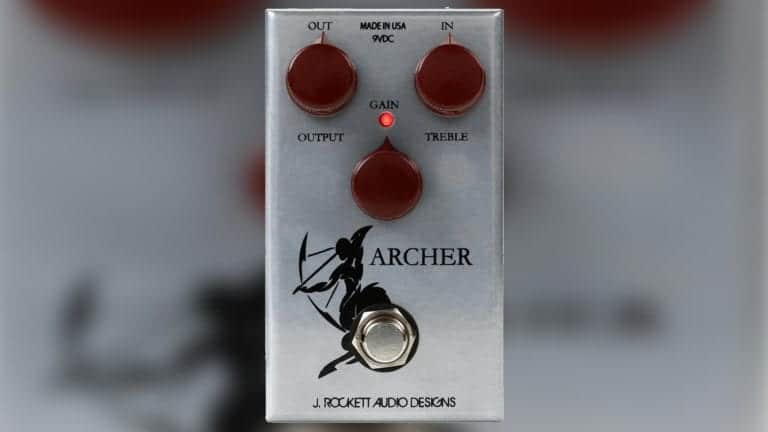
J. Rockett Archer
The most accurate Klon sound this side of an authentic Centaur.
Pros
- Augments your base tone
- Great dynamics and response
- Can run at 18V for increased headroom
Cons
- Not ideal for higher gain settings
Buy from
We may earn a commission from these links.
The Klon Centaur is one of the most mythical overdrive guitar pedals, transparent or not. Originals fetch ridiculous amounts on the used market, but now there are a variety of similar circuits to choose from.
Each has its own merits, but the Archer is up there with the best. J. Rockett did an excellent job honoring the tradition of the original, even down to the Davies 1470-style control knobs. It runs at the standard 9 volts, but can be boosted to 18 volts via an internal charge pump if you want to raise the headroom.
Unlike a lot of other overdrive guitar pedals, it’s meant to augment your original tone, not step on it or replace it. There isn’t as much gain through it alone as you might expect. But what it does, it does very well.
It plays nice with other pedals, and even though there are only three controls the spectrum of tones you can coax out of it is impressive.
If you want to add the sound of a Centaur-style overdrive to your signal chain and don’t feel like spending thousands to get it, the Archer is a top choice.
Best transparent overdrive guitar pedal: Electro-Harmonix Soul Food
Best transparent overdrive guitar pedal

Electro-Harmonix Soul Food
An affordable overdrive with good gain range.
Pros
- A lot of gain range
- Works well with different kinds of pickups
- Active Treble control
- Switchable bypass settings
- Good for modding
Cons
- None
Buy from
We may earn a commission from these links.
Transparent overdrive pedals are their own subset in the world of gain effects. The Centaur and Timmy paved the way, and now there are all kinds of different models. But they all have the same intent. Add to the original tone relationship of the guitar and amp without stepping on it.
The Soul Food isn’t the flashiest option out there, but what it does it does really well. From a simple clean boost to saturated sounds it works well with different types of pickups and still maintains clarity.
At higher settings, the drive control boosts the midrange frequencies, and the treble knob is the perfect way to customize the pedal’s sounds for the type of pickups you’re using. Boosted power rails guarantee headroom range and clarity.
It’s always good to have a transparent overdrive pedal at your disposal, and the Soul Food is a perfect marriage of build quality, tone, and affordability. There is also a bass version with an additional control for blending in dry signal.
Best budget overdrive guitar pedal: MXR M66S Classic Overdrive
Best budget overdrive guitar pedal

MXR M66S Classic Overdrive
A to-the-point overdrive that works in a variety of different ways.
Pros
- Reliable and durable
- Works well in different applications
Cons
- Tone might be a little too generic for true gearheads
Buy from
We may earn a commission from these links.
Overdrive pedals are traditionally pretty simple, and the M66S is no exception. And while it lacks a bit in controls it offers a great overdrive sound at a reasonable price point.
It’s not a pedal that’s meant to change your life. Utility and durability are what it’s about. And if you’re into circuit bending it’s a great platform to work with – as long as you’re comfortable working with PCBs.
What to look for in an overdrive pedal
Transparency vs. color
Overdrive pedals are often described as either transparent or colored. A transparent overdrive is designed to preserve much of your guitar and amplifier’s natural character while adding gain and breakup. A colored overdrive has a stronger sonic character and may significantly alter the frequency response of your rig.
If you already love the sound of your amp and just want to push it harder, a more transparent pedal may be the best choice. If you’re looking for a distinct sound that becomes part of your overall tone, a more heavily voiced pedal might be the better option.
Clipping character
The type of clipping in an overdrive circuit has a major impact on its character. Different clipping designs can produce everything from smooth, compressed breakup to sharper, more aggressive distortion.
Some pedals use symmetrical clipping for an even and compressed response, while asymmetrical clipping produces additional harmonic complexity and a more amp-like feel.
Gain range
Some overdrive pedals are designed primarily for low-gain sounds that add a little grit, compression, and harmonic richness. Others can push into heavier, more saturated space.
If you’re looking for a pedal that replicates the natural breakup of a tube amplifier, a low- to medium-gain overdrive may be the best choice. Players who want to use an overdrive as their primary source of distortion may want a pedal with a wider gain range.
FAQ
What does an overdrive pedal do?
Overdrive pedals simulate the warm, natural distortion you get when pushing a tube amplifier. It adds edge, sustain, harmonics, and makes your tone sound fuller without completely stepping on the guitar-to-amp natural tone.
Where should I place an overdrive pedal in my signal chain?
Most guitarists place overdrive pedals early in the signal chain, usually after a pedal tuner or wah and before modulation or time-based effects. If you’re stacking multiple gain pedals, try placing the milder overdrive first. This offers a more natural sound.
Are expensive overdrive pedals always better?
Not necessarily. Some boutique pedals offer unique tones and top-tier components, but many affordable models will deliver the sound you’re chasing.