Whether you’re a tone chaser, a performing pro, or just building your first pedalboard, guitar players always seem to be chasing tone. Experimenting with different types of guitar pedals is one of the best ways to stimulate creativity.
We’ve put together multiple guides covering different categories of effects pedals, so we took our favorites from each category across every major effect.
Best amp modeler: Fractal Audio Axe-FX III
Best amp modeler
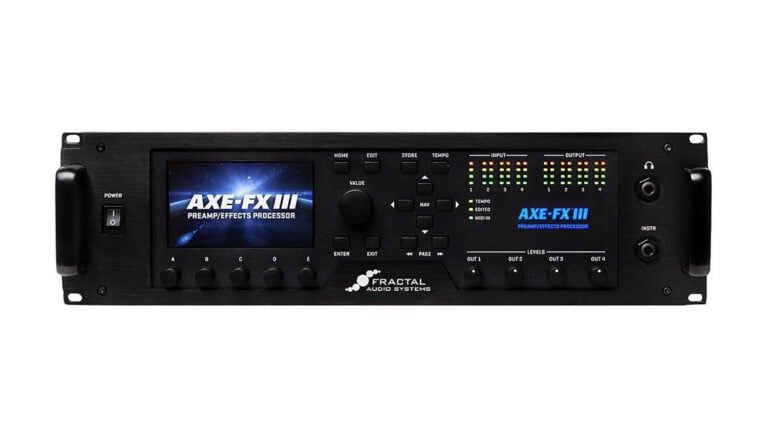
Fractal Audio Axe-Fx III
The gold standard for amp modeling.
Pros
- Front panel LED I/O monitoring
- Sleek front panel allows for quick entry
- Flexible I/O and routing
- High-quality circuit components
Cons
- Steep learning curve
- Expensive
Buy from
We may earn a commission from these links.
Amp modelers have come a long way and Fractal is one of the companies leading the charge. If you check out side-by-side comparison videos between Axe-FX sounds and the real amps they’re modeling it’s difficult to tell the difference.
Sounds are dialed in from the front panel and LED metering lets you keep an eye on your levels. The routing is just as flexible as the modeling. You can load your own impulse responses with up to thousands available including the ones that come onboard.
With an amp modeler this sophisticated it’s understandable that there is a steep learning curve that comes with it. But once you get the workflow down there isn’t anything you can’t do with it.
Best multi-effect guitar pedal: BOSS GX-10
Best multi-effect guitar pedal
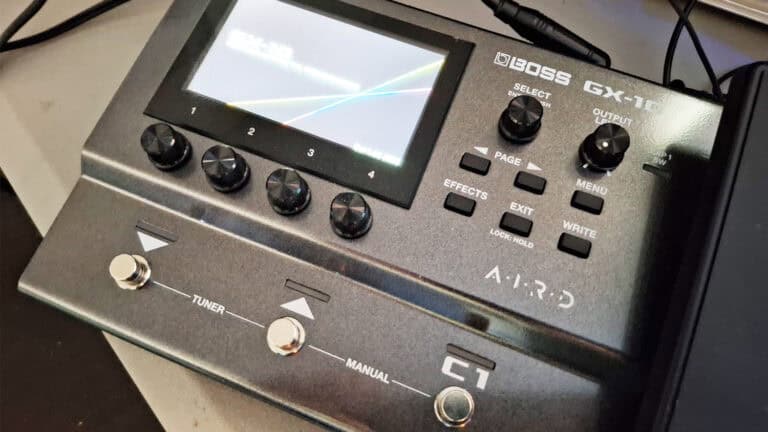
Boss GX-10
A versatile and ergonomic next-generation modeler built on BOSS craftsmanship.
Pros
- Amp models have authentic feel
- Powerful and realistic effects engine
- Good I/O
- Easy navigation through touchscreen or physical pots
Cons
- Learning curve for creating custom patches
- Not much cabinet or microphone customization
Buy from
We may earn a commission from these links.
We recently reviewed the GX-10, the most pedalboard-friendly model in BOSS’ GX series. There are 32 total amp models, 23 guitar and nine bass. Some amp simulations lack dynamics, but these respond well to playing articulation.
Each amp comes paired with a preselected cabinet and the microphones and positioning is fully customizable. BOSS’ and Roland’s lineup of effects is available, even some of the rarest models like the RE-201 Space Echo and Slicer with a total of 170 in all.
You can use either the touchscreen or control knobs below it to create signal flow and route things, and each is useful in different situations. There is some overlap in modern multi-effects and amp modelers.
The GX-10 is the best of both worlds.
Best overdrive guitar pedal: Ibanez Tubescreamer TS808
Best overdrive guitar pedal

Ibanez TS808 Tube Screamer
The most popular overdrive for a reason.
Pros
- Great for boosting the input of a tube amp
- Stacks well with other overdrives
- Usable gain through entire range of Gain control
Cons
- None
Buy from
We may earn a commission from these links.
It’s no surprise the most famous overdrive pedal of all time made the cut. It’s simple, but there are so many ways to use it.
Use it as a standard medium-gain drive, or with the gain down and the volume up to boost the input of your amp. Stack it with other drive pedals to create layered gain sounds, and it’s great in this application because it works with other kinds of overdrive, distortion, and fuzz pedals.
There are a lot of variants too, like the TS9. But the TS808 is the crown jewel of the series because the circuit is built around the 4558 op-amp. The biggest complaint with the TS808 though is the footswitch design, but it’s easy to get used to.
Best distortion guitar pedal: Mesa Boogie Throttle Box
Best distortion guitar pedal
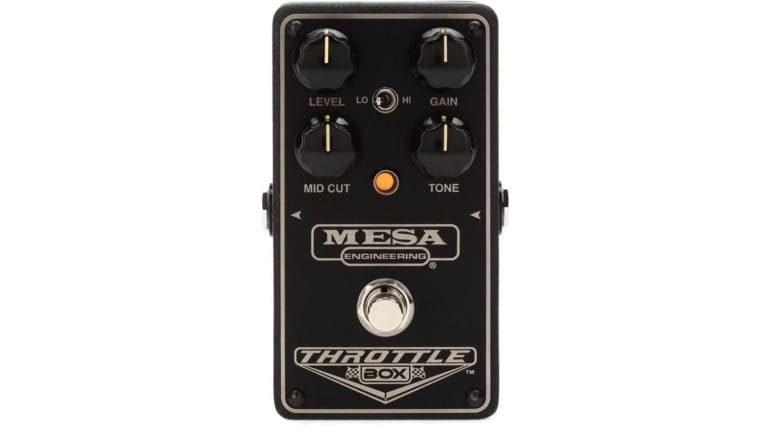
Mesa/Boogie Throttle Box
Mesa Boogie is one of the premier names in heavy tones. This small footprint pedal gives you larger than life sounds in a size that’s friendly on space.
Pros
- Great Mesa Boogie high gain sounds
- Mid cut gives scooped mid sound of the Mark V
- Pairs well with separate EQ pedals
Cons
- Too much gain for certain genres
Buy from
We may earn a commission from these links.
Mesa Boogie built their brand on some of the best distortion sounds around. The Throttle Box is best if you’re looking for high gain. It doesn’t get messy or indistinct when you push the knobs, and the inherent midrange frequency dip is great for a scooped sound popular in heavy music.
It pairs well with separate EQ pedals too, and guitarists like the EQ section so much Mesa Boogie offers it as a separate pedal in the Throttle Box EQ.
Best EQ guitar pedal: MXR 10-Band EQ
Best EQ guitar pedal
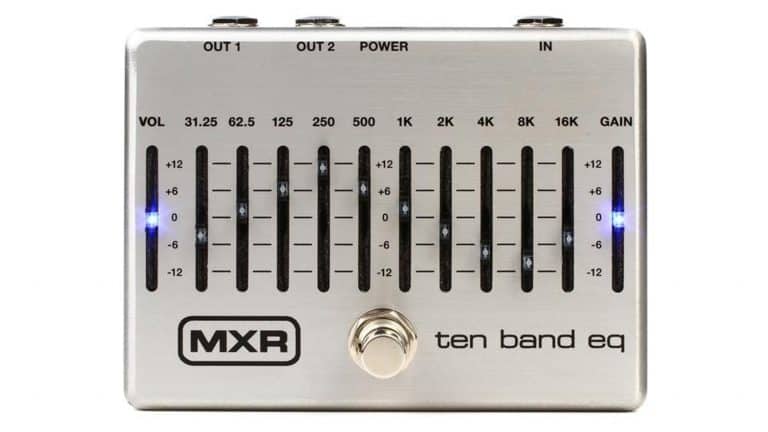
MXR M108S 10-Band EQ
One of the most versatile EQ pedals available that offers 10 bands and control over gain and volume. It can also be run at 18v for more headroom.
Pros
- 10 bands gives you total control over your equalization
- Gain and volume sliders make it easy to structure signal
- Good range of frequencies
- Can run at 18v for additional headroom
Cons
- Pedal might not fit in to some pedalboards due to its size
Buy from
We may earn a commission from these links.
EQ pedals can serve many purposes in a guitar pedal chain. They can be used to augment the equalization on an amp, a boost for solos that alters the tone to cut above a band mix, or be used to emulate the sound of different pickups.
However you want to use an EQ pedal, more bands offer more versatility. MXR’s 10-band EQ is one of the best workhorse guitar pedals, not just EQs, available. Aside from the frequency sculpting options there are sliders for input gain and output volume, and all have backlight LEDs that provide an easy visual.
It can run at standard 9v operation or 18v volts for increased headroom too. The only downsides are the size of the enclosure, about twice the size of a traditional pedal, and there is no stereo I/O. Most analog EQs don’t offer that anyway.
Best reverb guitar pedal: Strymon BigSky
Best reverb guitar pedal
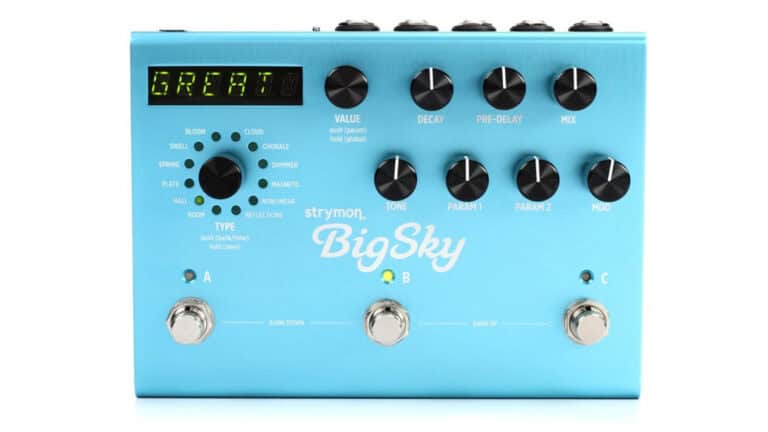
Strymon BigSky
From the DSP aces at Strymon, the BigSky is one of their reverb stations that has 300 presets, powerful editing, and versatile I/O.
Pros
- Peerless DSP
- 300 presets
- Powerful editing capabilities
- Mono, stereo, MIDI I/O
Cons
- Expensive
- Large enclosure
Buy from
We may earn a commission from these links.
Strymon has perfected DSP in guitar pedals and the BigSky is a full-on reverb workstation with 300 presets. It’s powered by SHARC, and it’s some of the highest-fidelity digital signal processing you’ll hear.
Twelve reverbs cover all the bases. Familiar ones like hall, room, spring, and plate are a given, but it’s the esoteric settings where things get interesting. Swell gives you pad sounds, Bloom builds up over time, and Cloud adds octave shifts. These 12 reverbs give you plenty of a creative base to let your imagination run wild.
Best chorus guitar pedal: BOSS CE-2W
Best chorus guitar pedal
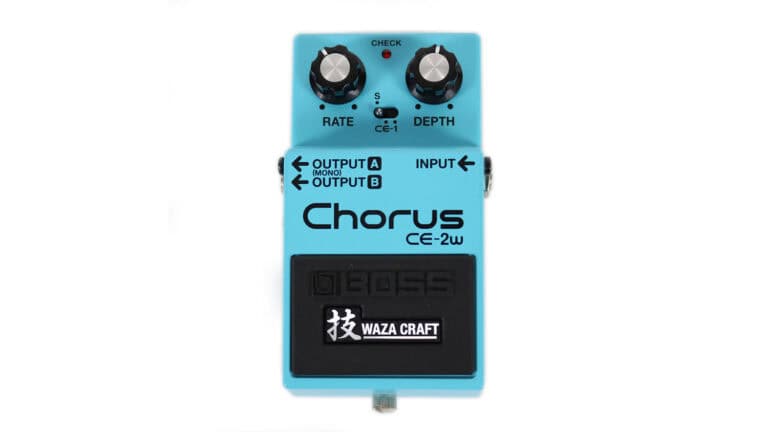
Boss CE-2W
If you’re looking to add the beloved BOSS CE-1 chorus sound to your rig but don’t want to drop hundreds of dollars on the used market this is as close as it gets!
Pros
- Timeless CE-1 sounds at an affordable price
- Stereo output
Cons
- Mono input only
- Not versatile enough for some players
Buy from
We may earn a commission from these links.
Other than the rare CE-1 chorus, which isn’t manufactured anymore (though you can find it on the Roland Jazz Chorus amps), the CE-2 is a player favorite chorus pedal and one of BOSS’ best. It was out of production for many years too until BOSS re-released it under the Waza Craft line.
With just two knobs for Depth and Rate the controls are a little limiting, but the sound is very organic. That’s due to the bucket brigade (BBD) circuit that classic powered many modulation effects. This lets you dial in lush chorusing that doesn’t sound thin and vibrato that doesn’t sound out of tune more than the effect is supposed to.
There are two modes – Standard and CE-1. So if you’re chasing the vaunted sound of the latter you don’t have to dish out the money for one on the used market. The only quirk is that it’s got stereo outputs but only a mono input.
Best octave guitar pedal: Electro-Harmonix Nano POG
Best octave pedal overall
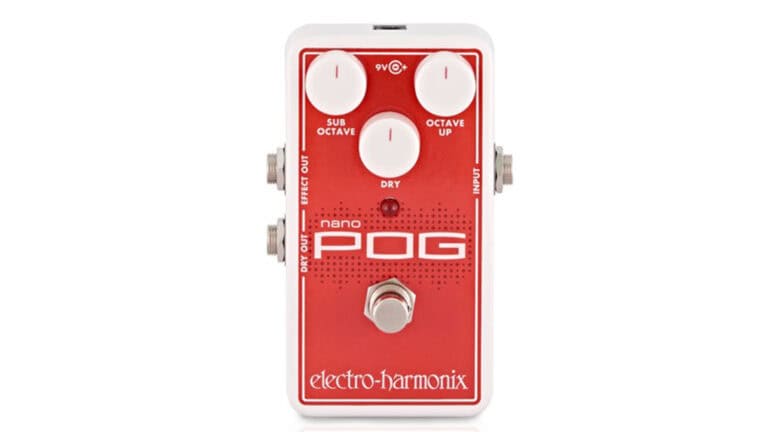
Electro-Harmonix Nano POG
The POG is pretty much the gold standard when it comes to octave pedals. It can go up or down in pitch and offers a useful blend control for mixing in dry signal.
Pros
- Octave up and down
- Dry blend control
- Dry output
- Ergonomic size
- Accurate tracking
Cons
- Only one octave either direction
- Mono only
Buy from
We may earn a commission from these links.
The Nano POG blurs the line between octave pedal, harmonizer, and pitch shifter. Semantics aside, it can conjure some very cool sounds with just a few controls with Octave Up, Sub Octave, and a Dry blend. Input is mono and output is stereo, but one of the outs sends a dry signal.
But don’t let the simplicity fool you. You can get organ sounds, simulate a bass or 12-string guitar, harmonize lead lines, get fuzzy sub octaves, or add it to a delay for a shimmer sound. The tracking is fantastic, and it’s just as good on chords as single notes.
If you want more robust control, Electro-Harmonix offers multiple other POG models that go all the way up to a full-fledged octave workstation.
Best pitch shifter guitar pedal: DigiTech Whammy 5
Best pitch shifter guitar pedal
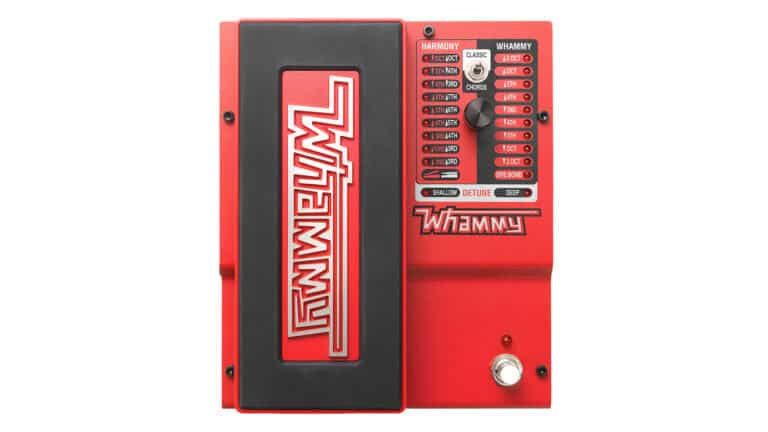
DigiTech Whammy 5
One of the original pitch shifter/harmonizer hybrid effects pedals is still the gold standard.
Pros
- Pitch shifter and harmonizer all in one
- Polyphonic or monophonic settings
- MIDI compatible
- Real-time control through treadle
Cons
- Large enclosure takes up a lot of pedalboard space
Buy from
We may earn a commission from these links.
The Whammy has seen a lot of iterations, and the fifth model in the lineup is the best of all worlds. Nine controls over harmony and whammy each give you a wealth of shifting options in one of the best pitch shifters.
A detune setting that simulates pushing down a guitar’s vibrato bar can be set to shallow or deep. It can be controlled in real-time through the treadle or as an effect.
MIDI control lets you connect it to any MIDI-enabled device to send/receive pitch information. This is perfect if you want to use another piece of MIDI gear to control it.
Its biggest downside is that you have to set it to monophonic (Classic) or polyphonic (Chords). The enclosure is large as well, which makes the MIDI option all the more appealing.
Best harmonizer guitar pedal: Eventide H9
Best harmonizer guitar pedal
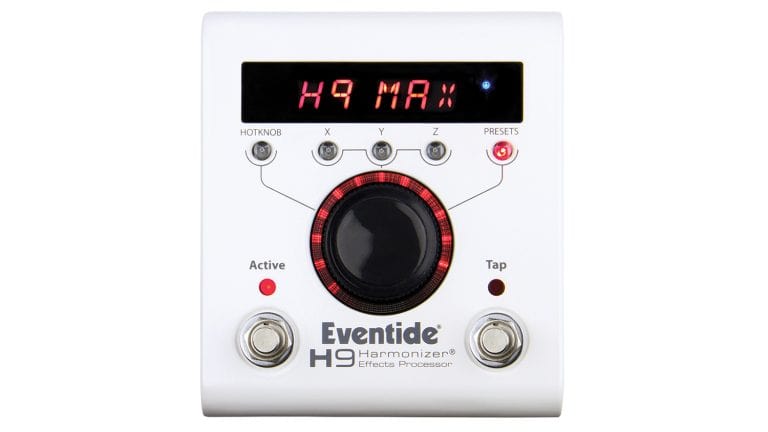
Eventide H9
Since the late 70s Eventide has been the premier name in harmonizing. This compact pedal packs in decades of high-end sounds.
Pros
- Timeless high quality harmonizer sounds
- Small format
- Robust I/O
- Upgradeable
Cons
- Expensive
- Can only use one algorithm at a time
- Learning curve with using it
Buy from
We may earn a commission from these links.
All of the classic Eventide sounds are here, but the H9 is much more than just a harmonizer. It includes a wealth of other effects like overdrives, modulation, delays, and reverbs. Parameters are dialed in through the single knob on the face, and alternate effects sounds with the X/Y/Z buttons above it.
Through the H9 Control software you can do deep customization on a PC, Mac, or iOS device. There’s MIDI and expression pedal connectivity, so no matter how your signal chain is designed it integrates easily.
There are some cons though. It’s pricey, has a learning curve, and you can only use one algorithm at a time. Eventide took off when the first Harmonizer released in the 70s, and they’re still pushing the envelope of guitar innovation.
Best volume guitar pedal: Korg XVP-20
Best volume guitar pedal
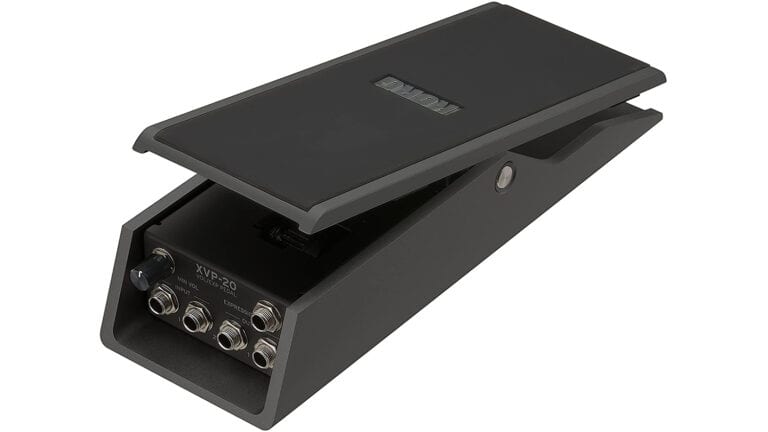
Korg XVP-20
A full-featured volume and expression pedal that fits into any rig.
Pros
- Mono and stereo I/O
- Volume and expression pedal functionality
- Non-slip rubber surfaces
- Minimum volume control
- Adjustable torque
Cons
- None
Buy from
We may earn a commission from these links.
Volume pedals are one of the most useful guitar accessories. The XVP-20 is a combo volume and expression pedal. Two sets of I/O let you use it in mono or stereo, with a separate one to use it as an expression pedal.
The aluminum enclosure is ergonomic and durable, and the gear mechanism of the treadle has a smooth, clean sweep. A minimum volume knob lets you adjust the range of the sweep, and the travel can be torqued to player preference.
What to look for in the best guitar pedals
Sound quality and tone
Listen for clarity, musicality, and how naturally the effect responds to your playing dynamics. High-quality pedals preserve the character of your guitar while enhancing it rather than masking it.
Distortion and overdrive pedals should clean up when you roll back your guitar’s volume; delay and reverb pedals should produce rich, natural repeats without overwhelming your original signal.
Consider whether you prefer vintage-inspired warmth, modern precision, or something in between.
Analog or digital?
Effects are available in both analog and digital formats, and each offers unique advantages.
Analog pedals are known for their warmth, organic response, and musical imperfections. Digital pedals excel at versatility, precision, and advanced features such as multiple effect algorithms, presets, stereo operation, and extensive customization.
Understanding the strengths of each helps narrow your options based on your playing style and desired sound.
Versatility and long-term value
Some pedals excel at producing one sound, others provide a broad range of tones. Consider whether you need a highly specialized effect or a versatile pedal that can adapt as your playing evolves.
Features like presets, multiple operating modes, connectivity options, and MIDI integration can extend a pedal’s usefulness for years, which makes for a worthwhile investment even if the initial cost is higher.
FAQ
What are guitar pedals and why do I need them?
They’re small signal processors designed to work with an unbalanced/TS guitar signal. They modify your guitar’s sound in different ways to shape your tone.
Can I use multiple pedals at once?
Yes. Most guitarists use more than one pedal at the same time. Stacking pedals is one of the best ways to discover new sounds. Just be aware of signal degradation and consider using a buffer (a lot of pedals have them built in) or effects loop if you need to.
Do I need a power supply or can I use batteries?
Some pedals can run on 9V batteries, but a dedicated power supply is more reliable, especially if you use multiple pedals. Isolated power supplies are ideal because they avoid noise, interference, ground loops, and protect your gear from “dirty” power.