A guitar amp is one of the two most critical parts of any signal chain. You need one that complements your choice of guitars and works with whatever pedals or effects units you use to create a cohesive tone.
The best guitar amps offer quality tone, useful controls, and additional features that suit each individual player. Here are our top picks in a number of categories so you can find the best match for your sound.
Best high-end guitar combo amp: Vox AC30 Custom
Best high-end guitar combo amp overall
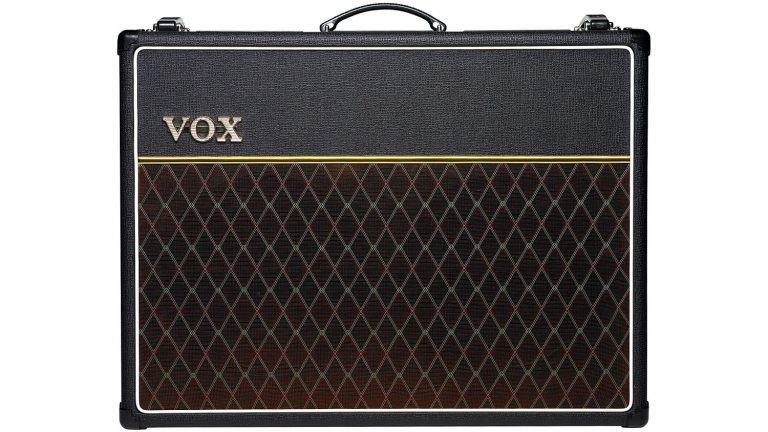
Vox Custom AC30C2
A reimagining of one of the most identifiable amps of all time.
Pros
- Iconic British sound
- Top Boost for adding high end
- Onboard tremolo
- Works well with pedals
Cons
- Too loud for many applications
- Heavy
- No reverb
Buy from
We may earn a commission from these links.
The AC30 has been one of the high end guitar combo amps since the 1960s. There have been a lot of iterations over the years, and the Custom combines features from across the decades. It includes the famous Top Boost circuit for adding high end, and the onboard tremolo is lush and organic.
Oddly there’s no reverb. But this amp can get loud! A lot of players use a guitar amp attenuator so they don’t have to sacrifice tone for reasonable volumes. It’s one of the best clean amps, but make no mistake it can get dirty without losing that charming British chime.
Best stereo guitar amp: Roland Jazz Chorus JC-120
Best Stereo Guitar Amp Overall
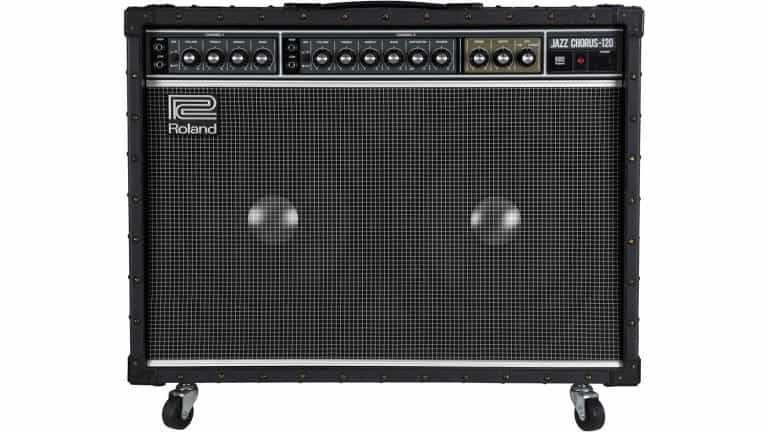
Roland Jazz Chorus JC-120
The Roland Jazz Chorus JC-120 may have been around for some time, but it still easily holds its own as the best stereo guitar amplifier out there.
Pros
- Stunning clean tone
- Great chorus and reverb effects
- Strong build
Cons
- A little bulky
- Built-in distortion isn't great
Buy from
We may earn a commission from these links.
Possibly the most famous solid-state amp ever, the JC-120 has a lot going for it. It’s a two channel stereo amp with reverb, but the effects magic is in the onboard chorus/vibrato.
It includes the same revered circuit found in the discontinued BOSS CE-1. Thick, lush, analog chorus and vibrato sounds that cost exorbitant amounts on the used market.
Each of the two input channels has a high and low input (for passive and active pickups respectively) and 3-band EQ. The effects loop is also stereo.
It has amazing clean sounds and the light weight and caster wheels make it easy to transport, even if it is a little bulky.
Best clean guitar amp: Fender ‘65 Deluxe Reverb
Best clean tube guitar amp
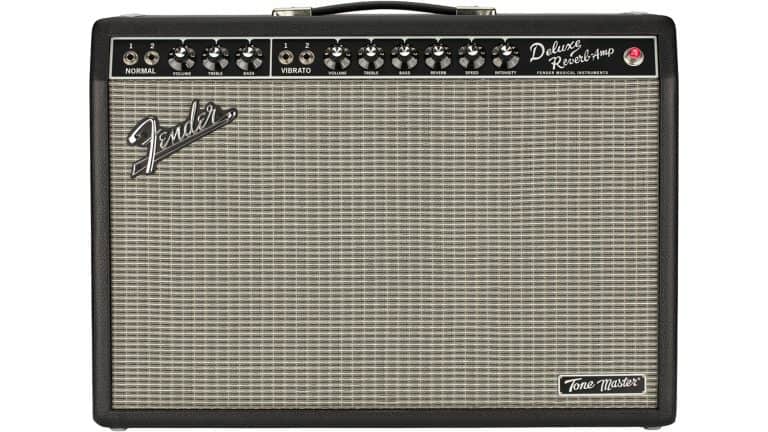
Fender ’65 Deluxe Reverb
One of Fender’s all-time classics got that reputation for a reason. This amp is a great mix of tone, portability, and power.
Pros
- Small but powerful 22W, 2×10 combo amp
- Works with any genre
- One of Fender's all-time classics for a reason
Cons
- No effects loop
- Some players might need more wattage
Buy from
We may earn a commission from these links.
Fender has a lot of classic guitars in their storied history, and the 1965 Deluxe Reverb is up there with the best of them. It’s a portable 22 watt, 2×10 high end combo amp that produces some of the best clean sounds you’ll ever hear.
Purists who want to plug straight in can just turn a few knobs and have that iconic Fender amp tone. It’s a great platform for pedals too, and the tube circuit really brings effects to life.
There isn’t an effects loop though, so if you want to use pedals everything has to go in through the front end.
Best mini amp head: Marshall 2525H Mini Silver Jubilee
Best mini amp head overall
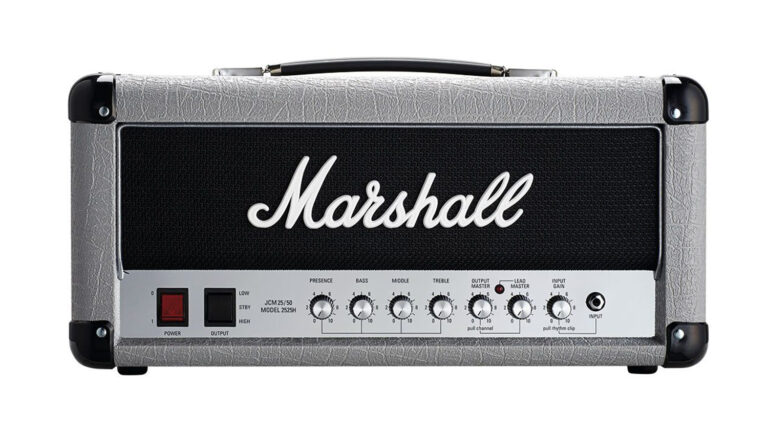
Marshall 2525H Mini Silver Jubilee
Marshall’s famous 25th anniversary amp can now be played at bedroom levels. The output can be scaled down to 5W and it can run speakers at different impedance levels.
Pros
- One of Marshall's most famous sounds in a smaller package
- Can be played at 20W or 5W
- Can run speakers at 4,8, or 16ohms
Cons
- As expensive as the large head
Buy from
We may earn a commission from these links.
The Silver Jubilee has a unique story. It was released in 1987 to commemorate Marshall’s 25th anniversary and was only manufactured for a single year. But it caught the ear of some big names like Slash and John Frusciante, who still use it in their backline.
For decades players wanted a re-release, and finally got one in 2015. But not every guitarist wants or needs a half stack. That’s what makes this mini amp version so perfect. It’s got the classic Jubilee sound in a much more convenient package.
Wattage was scaled down from 100W to 20W, and an onboard attenuator lets you scale it down to a cool bedroom-level 5W without sacrificing tone quality. It can feed into a single or dual 4, 8, or 16 ohm cabinets, has an effects loop, and DI.
At $1,300 new it’s still a top-tier price point, but as far as tone goes it’s in a class all its own.
Best mini guitar amp: Orange Crush Mini
Best mini guitar amp overall
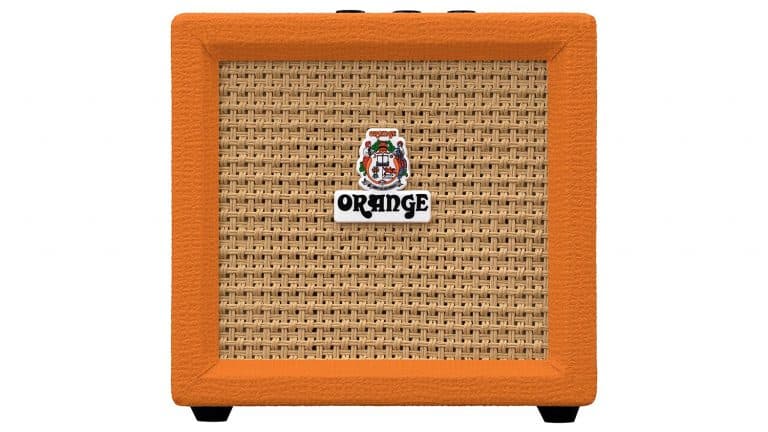
Orange Crush Mini
Get all of that great British sound everyone loves. With a good amount of gain, an onboard tuner, and auxiliary input this Orange packs a punch.
Pros
- 8ohm output for connecting to external speaker cab
- Aux input for jamming along to tracks
- Tuner
Cons
- Best for gain sounds, not the best clean tone
Buy from
We may earn a commission from these links.
To be clear, we define mini guitar amps as small, low wattage practice amps. And this 3 watt wonder is one of the best. The single channel pumps through a 1×4” speaker with controls for gain, volume, and shape (EQ) to craft the tone.
What makes it such a great tool for writing, jamming, practicing, or even recording are the extra features. It has a built-in tuner, headphone output for silent playing, auxiliary input for jamming to tracks, and an 8 ohm speaker output for powering an external cabinet.
You can run it on mains or battery power too.
Best acoustic guitar amp: Fender Acoustic 100
Runner-up acoustic guitar amp
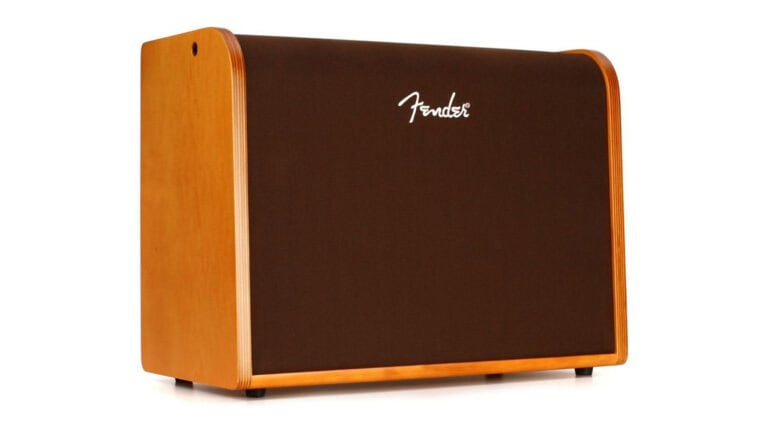
Fender Acoustic 100
An affordable 100W acoustic amp that has a retro look and inputs for guitars and microphones.
Pros
- Cool vintage look
- Combination XLR/TS inputs
- Onboard FX and tuner
Cons
- 8" speaker might not have enough bass response for some
Buy from
We may earn a commission from these links.
There are a lot of reasons acoustic guitar amps come in handy, and the Acoustic 100 is one of the most unique. It pumps out an impressive 100 watts over two channels. Each input is a combination XLR and ¼” design, so you can use it as a PA system too!
It only sports a single 8” speaker, but it is full range. Each channel has controls for volume, a 3-band EQ, effects selection, and effects level control. And the effects suite is impressive. It includes room and hall reverbs, tape echo, delay with repeats, chorus, vibrato, delay with chorus, and delay with hall reverb.
The enclosure has a sleek vintage vibe too with a wood frame and brown grille cloth. For solo performers this is a great acoustic amp that will come in handy in a lot of situations.
Best guitar amp pedal: Hughes and Kettner Amp Man
Best guitar amp pedal overall
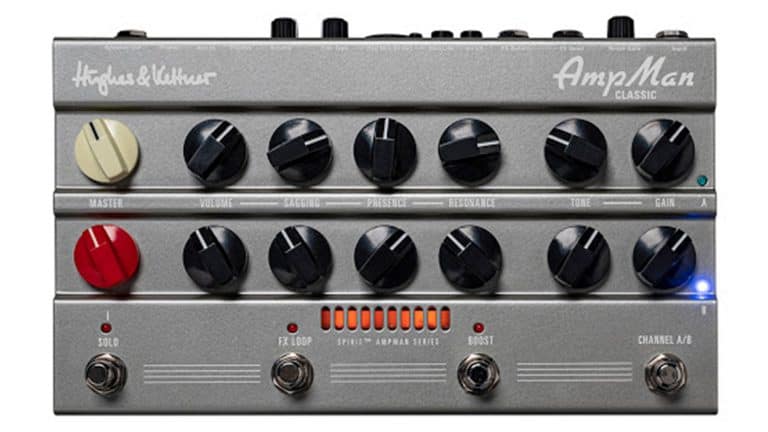
Hughes and Kettner Amp Man
50W guitar amp pedal with two channels that can power external speaker cabinet. Comes in two tone styles – Classic and Modern.
Pros
- 50W guitar amp pedal
- Can output to speaker cabinet(s)
- Easy to integrate pedals with it
Cons
- Fairly expensive
Buy from
We may earn a commission from these links.
You don’t need to lug around a physical amp anymore to get realistic tones. There are a lot of guitar amp pedals, and the Amp Man is one of the best. It’s simple, but it focuses on sound quality and not distracting features that most players probably won’t use.
Don’t think of it as a pedal, because it’s really more of a preamp on the floor. It’s set up with fifty watts through two channels. Each channel has individual gain, tone, resonance, presence, and volume controls as well as sagging to replicate the performance of a tube amp. The onboard noise gate lets you push the gain without worrying about noise.
It’s equipped with a Red Box DI with eight selectable cabinet types. So you don’t even need an external cabinet, but there is a 4-16 ohms cabinet output if you do want to push air. This is great for quick setup for recording or going straight to the board for performances. There’s even an effects loop.
What to look for in a guitar amp
The right amp type
The first decision is whether you want a tube, solid-state, modeling, or hybrid amplifier.
Tube amps have a warm, dynamic tone. Solid-state amps are generally more affordable, reliable, and require less maintenance while delivering consistent performance.
Modeling amps use digital technology to recreate the sounds of different amplifiers and effects, making them an excellent choice for versatility. Hybrid amplifiers combine tube and solid-state components to offer a balance between traditional tone and modern convenience.
Speaker size and cabinet design
Speakers play a major role in shaping an amplifier’s overall sound. Smaller speakers, like 8-inch and 10-inch models, typically emphasize tighter, brighter tones that work well for low-volume playing.
Twelve-inch speakers are a standard because they offer a balanced combination of bass response, clarity, and projection. Larger cabinets with multiple speakers move more air, which creates a fuller sound that fills larger rooms and stages.
Whether you choose a combo amp or a separate head and cabinet should depend on your portability needs and desired tonal flexibility.
Tone controls and EQ options
A quality guitar amp should give you enough control to shape your sound without making adjustments overly complicated.
Most include bass, middle, and treble EQ controls as well as gain and master volume. More advanced models may add presence and resonance. Some amps also feature multiple voicings or EQ presets that allow you to quickly switch between different tonal characteristics.
A flexible equalizer makes it easier to adapt your sound to different guitars, pedals, and environments.
FAQ
Is a 20 watt amp too loud for playing at home?
Twenty watts is plenty of power for home use. It might actually be too much for some scenarios. Anything between five and 20 watts is plenty, even better if your amp offers power scaling to reduce the wattage when necessary.
How important is speaker size for electric guitar amps?
Speaker size has a much more critical effect on an amp’s tone than most realize. Larger speakers reproduce low end better, which is why 12” and 10” models are outfitted in a lot of speaker cabinets and combo amps. Large speakers also move more air, so they produce more volume.
Can I record electric guitar without a physical amp?
Yes. You can go direct into an audio interface with amp modelers, plugins, or multi-effects units.