There’s no disputing the advantages that wireless microphone systems offer. They give you freedom to move around the stage and not worry about long runs of cabling. These are just a few of the true benefits of the technology.
We’ve run down some of our favorite wireless systems under the $500 price range. But you might have a little more spend to work with and be looking for something over that threshold.
These include features like swappable capsules, hand-held condensers, and systems that can be compounded for large setups. We’ve gone over the best wireless microphone systems under $500, let’s look at higher-end models.
Best wireless microphone system overall: Shure GLX-D with BETA 87A
Best wireless microphone system overall
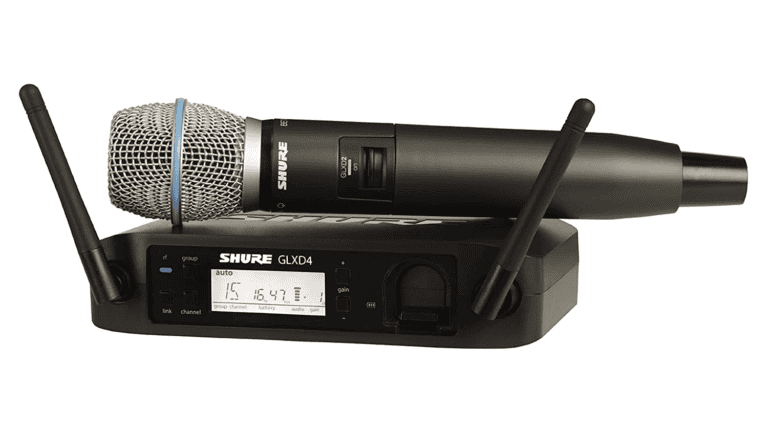
Shure GLX-D with Beta 87A
This handheld condenser offers less proximity effect, a pleasant boost in the upper midrange, and automatic frequency detection. It also comes in a SM58 version.
Pros
- Cardioid handheld condenser
- Less proximity effect than other models
- Frequency response with peaks in upper mids
- Automatically detects frequencies
Cons
- None
Buy from
We may earn a commission from these links.
Shure’s GLX series is a great line of wireless microphone systems that come in multiple models. This version comes with the BETA 87A capsule, a cardioid condenser microphone that provides the clarity and articulation of a standard condenser in a convenient wireless setup.
This type of mic design has a lot of benefits. Proximity effect is alot less pronounced than with standard dynamics, and mic technique plays more into getting a great sound out of it. The frequency response has some peaks in the upper mid range, letting the signal to cut through with minimal EQ.
It’s got good battery life, running at around 16 hours on a full charge of Shure’s proprietary lithium rechargeable batteries. A real-time display lets you see the battery life within 15 minutes either way.
The mic is light and easy to perform with, but that’s not the best feature. The Automatic Frequency Management identifies open channels, taking the guesswork out of setting it up.
XLR and TRS output connections add versatility, and it’s compatible with up to eight other Shure systems. If you’re not a fan of the Beta 87A sound, the GLX-D system offers a unit with the SM58.
Best high end wireless microphone system: Shure SLX-D4 Combo System Wireless Bundle Band G58
Best high end wireless microphone system
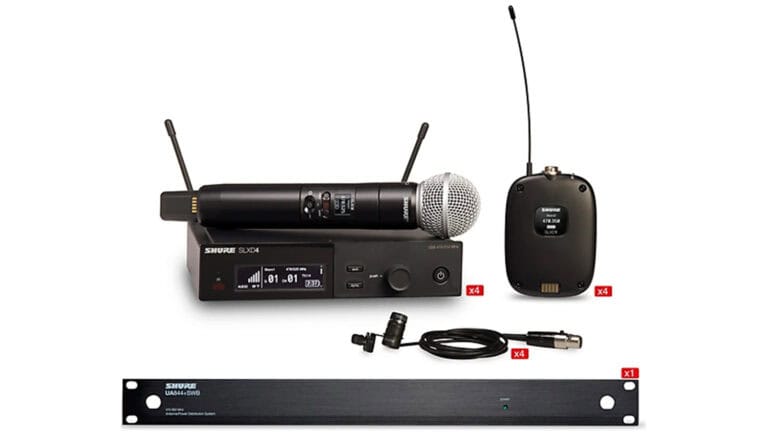
Shure SLX-D4 Combo System Wireless Bundle Band G58
This advanced wireless microphone system comes with a half-rack receiver and finds available frequencies with one touch.
Pros
- Half-rack digital wireless receiver
- Seeks available frequencies with one-touch button
- 10 hour battery life
- Ethernet networking
Cons
- Expensive
- Best used as part of a rack enclosure
Buy from
We may earn a commission from these links.
With Shure’s digital wireless technology, the SLX4D transmits detailed audio at a flat frequency response. This gives you a totally clean sonic slate to process the signal however you like.
One touch automatic channel scanning picks up open frequencies quickly. This makes setup a breeze. Through AES-256 encryption you can set up secure transmission accurately and easily.
It can be powered with two AA batteries or Shure’s lithium-ion battery and offers around 10 hours of battery life. It’s a half-rack size, so you can secure it without taking up an entire 1U of space.
It’s no surprise one of the best microphone manufacturers of all time is behind the engineering. If you’re looking for a high end, next-level wireless system to make a large investment in, this is it.
Best dual wireless microphone system: Audix AP42 OM2 Dual Handheld Wireless System
Best dual wireless microphone system
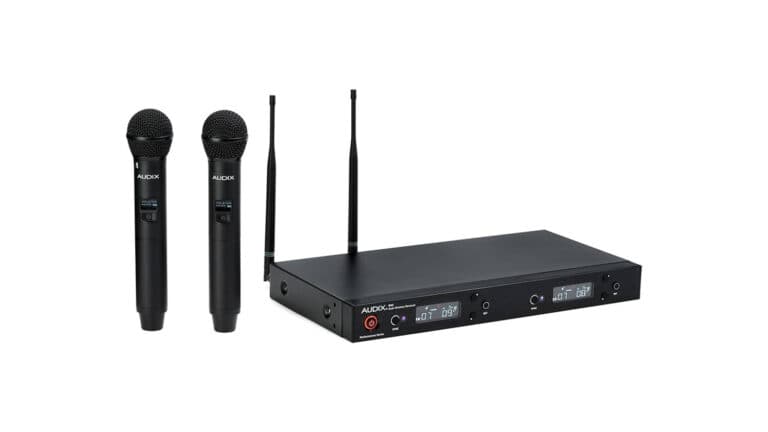
Audix AP42 OM2 Dual Handheld Wireless System
Audix’s best-selling vocal microphone in a wireless system times two.
Pros
- Rackmountable receiver
- Great for vocals and instruments
- Good transient response
- Built-in EQ profile perfect for vocals
- Easy setup with Scan and Sync
Cons
- Not best choice if you only want one microphone
Buy from
We may earn a commission from these links.
This is one of the best dual wireless microphone systems. It’s excels on vocals especially, with a built-in frequency curve with strength in the low mids and a modest midrange boost thanks to the VLM type-B capsule. Superior transient response translates to reliable accuracy as well.
A hypercardioid polar pattern keeps off-axis bleed to a minimum, and through Scan and Sync keys setup is as easy as pressing a few buttons. An operating range of 300 feet frees everything up, and there is additional flexibility with XLR and 1/4″ outputs.
It’s great as a primary unit for redundancy if microphone A goes out, or for situations with dual vocalists, or for using one mic for vocals and the other for instrumentation.
Best wireless microphone system with swappable capsules: Sennheiser EW 500 AW+
Best wireless microphone system with swappable capsules
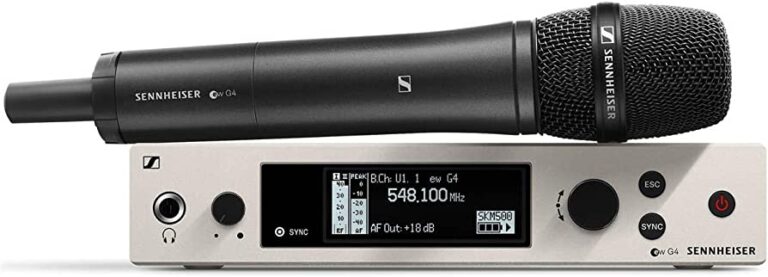
Sennheiser EW 500 AW+
The EW 500 AW+ features swappable capsules, can stack with multiple systems, and offers control software for fine-tuning.
Pros
- Capsules can be swapped for different sounds
- Can stack systems up to 32 channels
Cons
- Not rackmountable
Buy from
We may earn a commission from these links.
The EW 500 is relied on by professionals all over the world. It stands out among alternatives due to the swappable capsules. This gives you the options to turn it into an e935, e945, or e965.
It offers up to 88MHz in bandwidth across a maximum of 32 channels. And if you’re using it in a multi-channel configuration the Wireless Systems Manager controller software gives you access to sophisticated ways to coordinate frequencies.
The mic itself is lightweight and comfortable to hold, and the receiver conveniently fits into a half, 1U rack space. It’s not directly rackmountable, but there are ways around that. It’s flexible, expandable, and with the swappable capsules you can tailor it perfectly for the situation.
Best streamlined wireless microphone system: Electro-Voice RE3-ND96
Best streamlined wireless microphone system
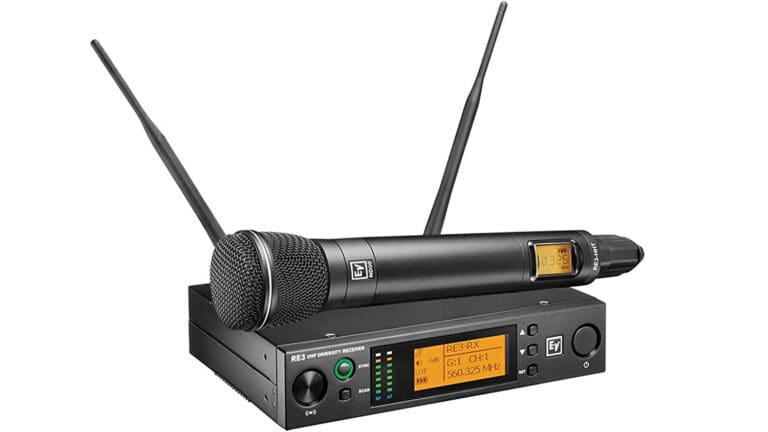
Electro-Voice RE3-ND96
This model is great for live use. It handles high SPLs, has low handling noise, and different EQ curve options.
Pros
- Tuneable frequency response to EQ as needed for the source
- Handles high SPLs
- Low handling noise
Cons
- Price range higher than other options
Buy from
We may earn a commission from these links.
Electro-Voice has been around for decades, but their products don’t get as much respect as they deserve. This model offers a perfect balance of sound options, durability, utility, and ease of use.
The frequency response is tuneable to cut certain parts of the low-midrange and give a little lift to the higher parts of the mids. Handling noise is always a concern, but in this mic it’s reduced with a shock mounted capsule through a 4-point suspension system and pump.
It can handle high SPLs and its gain-feedback structure is top notch. Readouts on the mic and receiver are easy to read, even in the dark. Its price range is a little higher than most, but you won’t find the analog signal it offers in other models very easily.
Best modeling wireless microphone system: Line 6 XD V75
Best modeling wireless microphone system over $500
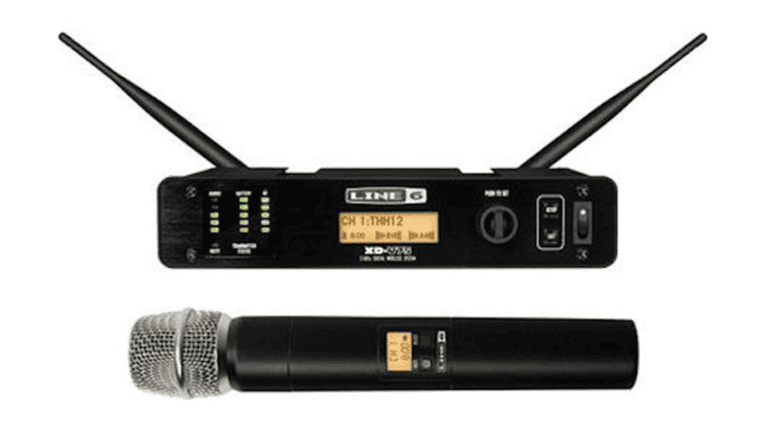
Line 6 XD V75
This Line 6 wireless mic system models 10 different mics and has a full frequency range, making it one of the most versatile options.
Pros
- Models 10 different microphones
- Full frequency range
Cons
- Modeling adds more configuration decisions
Buy from
We may earn a commission from these links.
You’ll see Line 6 wireless units creeping up in a lot of artist’s setups. Their digital wireless systems have earned their reputation. One of the reasons is that their technology doesn’t use what’s called signal companding. This opens up the full dynamic range, one of the reasons a lot of people prefer wired mics.
But the coolest part of what the XD V75 can do is that it models 10 different popular microphones like the SM58, Sennheiser e835, and more. The frequency range is 10Hz all the way up to 20kHz, and it operates in the 2.4GHz band, which reduces interference.
Modeling is a really innovative feature, and you can bet you’ll start seeing more models offering it as the technology continues to get better.
Best condenser budget wireless microphone system: Rode RODELink Performer Kit
Best condenser budget wireless microphone system
Rode RODELink Performer Kit
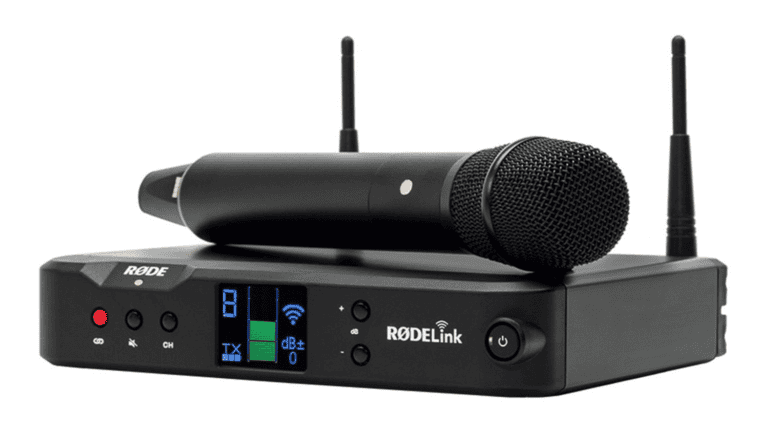
The Rodelink Performer is a versatile wireless mic option that uses encrypted transmission for the best signal and comes with a variety of necessary accessories.
Pros
- Good for a variety of industries
- Encrypted transmission reduces chances of interference
- Comes with a variety of accessories
Cons
- Works best within 100m range
Buy from
We may earn a commission from these links.
This all around wireless microphone system option is great for any application. Live sound, speech, theater, even film. Most wireless mics are dynamics, but this unit from Rode is a handheld condenser.
The transmitter and receiver work right on setup without the need for channel selection. It pulls this off by running on a secured Series II 2.4GHz, 128-bit digitally encrypted transmission across a 100m distance.
Sent on two simultaneous channels, and RodeLink chooses the strongest signal to ensure the signal strength is as secure as a wired connection.
A handy mute switch on the body of the mic adds to the versatility, and it’s a great complement to the inherent low handling noise. It’s powered with the included rechargeable battery for a max use of 10 hours, or dual AAs with a max of six hours.
Every accessory you need for it is included in the purchase. Other than the mic and receiver the kit comes with a rechargeable lithium-ion battery, mic clip, micro USB cable, and case. If you buy it new you also get a 2-year warranty.
What to look for in a wireless microphone system
Frequency range and signal reliability
One of the most important factors is how the system handles frequency transmission. Systems operate on different bands (commonly UHF or 2.4 GHz), and each has trade-offs.
UHF systems generally offer better range and less interference in crowded RF environments, making them a go-to for professional applications. Meanwhile, 2.4 GHz systems are more plug-and-play but can be susceptible to interference from Wi-Fi and other device signals.
Look for systems with automatic frequency scanning or selection to help avoid dropouts and ensure a stable connection and easier setup.
Audio quality and latency
Wireless convenience shouldn’t come at the expense of sound. Pay attention to frequency response, dynamic range, and whether the system uses digital or analog transmission.
Digital systems tend to offer cleaner audio and better resistance to noise, while analog systems can sometimes provide more natural compression characteristics.
Latency is another key consideration, especially for performers. Even a slight delay can be distracting, so low-latency performance is essential for live monitoring.
Range and line-of-sight performance
Manufacturers often advertise impressive operating ranges, but real-world performance depends heavily on obstacles and interference. Walls, metal structures, and even crowds can reduce effective range.
If you’re working in dynamic environments, look for systems that maintain strong line-of-sight performance and include diversity receivers (dual antennas) to minimize signal dropouts.
FAQ
What is a wireless microphone system?
Wireless microphone systems allow audio to be transmitted without a physical connection to a sound system. They typically consist of a microphone (handheld, lapel, or headset), transmitter, and receiver. The transmitter sends the audio signal wirelessly to the receiver, which connects to the sound system.
What wireless mics do pros use?
Professionals use a variety of wireless mic systems, so it’s hard to narrow down a specific model. It depends on what sound and feature set they prefer, what the techs on the crew like to work with, even what part of the world they’re in. But they usually stick with the standard contenders like Shure, AKG, Sennheiser.
Which is the best wireless mic?
For live sound, yes, generally a wireless mic system will only work if the signal is sent out to a sound reinforcement system. But if you’re recording the signal can be sent to an interface preamp.
Can a wireless microphone work without a speaker?
Yes. They’re best for live use where the signal can flow into a sound reinforcement system, but it’s a microphone so it just needs a preamp to increase the signal. This means you can run it in the studio into your interface.