When it comes to professional recording, high-end audio interfaces are the heart of any setup. These models offer unmatched clarity, dynamic range, and reliability that elevates any project to professional quality.
These interfaces feature premium converters, ultra-low latency, and build quality designed for demanding sessions. Whether you’re a producer, mixing engineer, or musician building a world-class rig, investing in a top-tier audio interface ensures every note and nuance is captured with precision.
We’ve gone through the best audio interfaces under $1,000 before, so all of the high-end audio interfaces here will be over $1,000.
Best high-end audio interface overall: Lynx Aurora(n) 24
Best high-end audio interface overall

Lynx Aurora(n) 24
One of the most versatile interfaces for professional audio.
Pros
- Multiple connectivity options
- Works with ProTools|HD and Dante
- Self-contained
- Separate converters for each stereo channel pair
Cons
- Expensive
- Thunderbolt standard isn't available to everyone
Buy from
We may earn a commission from these links.
Lynx is a brand that is dedicated to creating the highest-quality audio production gear and this is the pinnacle of their audio interface technology. It’s designed to integrate into modern studios, however they’re constructed.
It starts with the sonic clarity and transparency of Lynx converters, which is used in world-class facilities for a reason. Each channel has an analog signal path, and each channel pair has a dedicated converter. This reduces distortion and increases dynamic range.
Versatility comes in the LSlot Design, a future-proof connection method. Whether your recording studio or post-production facility uses USB, Thunderbolt, or more sophisticated methods like Dante or ProTools|HD, it connects easily.
Direct recording to the device comes with the built-in Micro SD card slot. With it you get 32 channels of real-time recording at 96k, with playback across 16 channels up to 192k.
The price point is high, but with so many innovative design features it’s an investment in the future. Audio standards and techniques are always subject to change, but this is a self-contained unit that serves as a gold standard centerpiece no matter how you choose to use it.
Best 8-channel high-end audio interface: Solid State Logic SSL 18
Best 8-channel high-end audio interface

Solid State Logic SSL 18
An affordable 8-channel interface with SSL quality.
Pros
- Versatile I/O options
- Configurable output levels
- High output dynamic range
- Flexible Mirror Routing system
- SSL preamps
Cons
- Takes time to learn depth of features
Buy from
We may earn a commission from these links.
This 8-channel unit features advanced 32-bit/192kHz converters that brings SSL’s analog expertise that delivers peerless sonic fidelity and 120dB of dynamic range.
Everything starts with the state-of-the-art microphone preamps. Two-stage circuitry ensures every source that flows through them retains the character of the performance and the microphones capturing them.
As for I/O, 10 balanced line outputs offer plenty of ways to connect the other elements of your studio. Like a lot of audio interfaces, channels 1 and 2 have Hi-Z inputs for direct recording. Advanced routing and monitoring paths can be configured through the digital mixer, which is especially useful for setting up cue mixes for artists.
Configurable output levels let you connect to many types of gear standards, and 16 channels of ADAT, MIDI I/O, and stereo S/PDIF works through optical or coaxial.
SSL has always been a premier name in analog recording, but their foray into audio interfaces is already equally impressive. If you’re shopping around for an 8-channel interface with serious features that won’t require a bank loan, there are few better choices.
Best 2-channel high-end audio interface: Universal Audio Apollo Twin X QUAD
Best 2-channel high-end audio interface
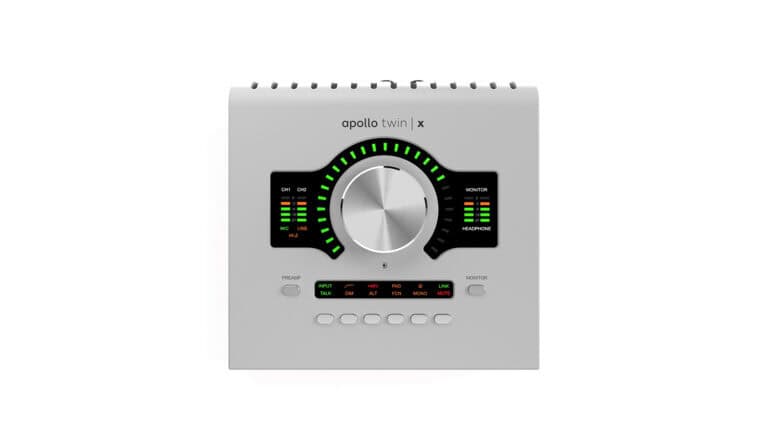
Universal Audio Apollo Twin X Quad Gen 2
One of the best ways into the UAD ecosystem.
Pros
- Unison preamps with emulations of classic gear
- UAD plugin compatible
- Plugin bundle included
- Onboard DSP
- Bass Management optimizes low frequency detail
Cons
- Expensive for just two channels
Buy from
We may earn a commission from these links.
As far as 2-channel audio interfaces go the Apollo Twin X QUAD is at the top of the heap. Available in Essentials+ and Studio+ versions, every stage of this model carries the UA seal of quality.
High-resolution converters ensure every detail translates, and Apollo Monitor Correction makes up for any deficiencies in acoustics. Unison preamps and QUAD Core DSP provide real-time recording with emulations of top shelf gear without introducing any latency.
It’s expandable too. Up to four Apollo interfaces can be daisy-chained for an insane 128 channels of I/O. ADAT and S/PDIF offer further expansion options. Dual monitor outs let you connect two pairs of studio monitors, and two ¼” line outputs allow for external studio hardware integration.
This is a stellar interface on its own, but factor in access to the UAD plugin bundle and you have an efficient all-in-one recording solution. It’s expensive for a 2-channel interface. But if you’re looking for a desktop unit rich in features, this is a great way into the Universal Audio ecosystem. It’s a great audio interface for songwriters too.
Best high-end audio interface for songwriters: Focusrite Clarett+
Best high-end audio interface for songwriters

Focusrite Clarett+
A reliable, 8-channel interface for songwriters.
Pros
- Clarett pres with Air from ISA mic preamp
- 18 inputs, 20 outputs
- Detailed metering and monitoring
- Remote control via mobile device
Cons
- Not as many features as other options in price range
Buy from
We may earn a commission from these links.
Every songwriter’s recording needs are different, so a versatility is one of the key things to look for in an interface. What you don’t want to do is be bound by creative limitations. For the most part, the Clarett+ solves a lot of the home recording issues faced by songwriters.
Eight preamps let you record everything from full bands, to a fully mic’d up drumkit, almost anything songwriters need. They have a wide gain range, low noise, and almost zero distortion. The first two channels have a switchable DI for catching ideas easily and silently.
ADAT connection expands the inputs to 18, and four line inputs let you connect external hardware like compressors and reverbs. Songwriters need options and get them with MIDI.
It’s not as rich in features as some alternatives, but it’s a well-crafted 8-channel interface and a solid building block for future expansion.
What to look for in a high-end audio interface
High-quality preamps
Preamps have a critical influence on how an interface handles input sources and performances. Professional-grade preamps should have plenty of clean gain, low self-noise, and enough headroom to accommodate dynamic recordings.
This is particularly important when recording ribbon microphones or quieter sources that require substantial amplification. Look for features like switchable phantom power for condenser microphones, high-pass filtering, polarity inversion, and input impedance options.
Accurate and versatile AD/DA conversion
Solid, accurate converters are among the most important components in high-end audio interfaces.
A-D conversion translates incoming analog signals from microphones, instruments, and outboard gear into digital audio. D-A converters turn digital audio back into an analog signal for monitoring through studio monitors and headphones.
Research elements like accurate conversion, low distortion, and a wide dynamic range. Look beyond advertised bit depth and sample rate to examine dynamic range, total harmonic distortion plus noise (THD+N), and real-world performance. 24-bit recording at common sample rates up to 192 kHz are useful, but better specs on paper don’t always equate to better sound.
Expandability
The number and type of inputs and outputs determine how well an interface fits your workflow. A solo musician just recording vocals and guitar may only need a few inputs, a professional studio tracking a full band could require eight or more.
Look for a combination of preamps, line-level inputs, DIs for instruments, balanced monitor outputs, and dedicated headphone outs. Digital connections like ADAT and S/PDIF can expand the system by allowing you to integrate additional converters or compatible equipment.
A lot of interfaces also support MADI or Dante networking for larger setups. Thunderbolt and USB connections are common options for computer integration, but compatibility, driver quality, channel count, and throughput matter more than the the type of connector.
FAQ
What makes a high-end audio interface worth the investment?
Premium interfaces come equipped with superior preamps, better quality converters, and clocking systems that provide cleaner, more accurate recordings. They also offer better build quality, low-latency performance, and advanced connectivity options for connecting them in a variety of different ways to all types of external gear, like rackmount effects.
Do expensive audio interfaces actually sound better?
High-end interfaces typically feature the best A/D and D/A conversion that captures the most amount of detail with a wider dynamic range. The result is clearer, more natural recordings that translate better across different studio monitors, but the mix balance is still a critical part of the final result.
What features should professionals look for at this price point?
Look for high-quality preamps, high sample-rate support, multiple input/output configuration options, and reliable clocking if you need to connect it to certain types of external equipment. Expandability through ADAT or word clock is key for growing studios and can save money down the line.